


-

About Flexfilm 2
-

Getting Started 10
-
Core Fundamentals 10
-
-

Orders & Support 83
-
Shipping 10
-
Dealer Rewards 13
-
Ordering & Account 7
-
Pre-Cut Patterns 2
-
General 9
-
Warranty 6
-
Billing & Tax 3
-
Route Package Protection 2
-
Returns & Refunds 2
-
Shop Pay 2
-
Training 1
-
Dealer & Installer Program 4
-
Selling & Quoting 9
-
Marketing & Growth 8
-
Business Operations 5
-
-

Installation Resources 19
-
Architectural 4
-
Automotive 5
-
General 10
-
-

Architectural Window Film 54
-
Safety & Compatibility 17
-
Ownership 2
-
Fundamentals 16
-
Buying Guides 4
-
Performance & Privacy 6
-
Product Guides 9
-
-

Automotive Window Film 40
-
Installation & Ownership 18
-
Product Guides 11
-
Legal & Compliance 3
-
Buying Guides 8
-
-

Tools 10
-
Cutting & Prep 3
-
Application 3
-
Measurement & Layout 2
-
Specialty 2
-
-

Plotters 8
-
Ownership 6
-
Buying Guides 2
-
-

FlexCut Software 25
-
Account & Licensing 5
-
Getting Started 10
-
Troubleshooting 2
-
Using FlexCut 8
-
-

Paint Protection Film (PPF) 10
-
Ownership 3
-
Fundamentals 4
-
Product Guides 3
-
-

Surface Coatings 13
-
Product Guides 7
-
Fundamentals 3
-
Ownership 3
-
Understanding Low-E Glass


Understanding Low-E Glass
Low-E glass is one of the most common types of energy-efficient glass used in modern homes and commercial buildings. Because Low-E coatings can significantly affect architectural window film compatibility, understanding what Low-E glass is and how it works is an important part of selecting the right window film.
If your home or building was constructed within the last several decades, there is a good chance some or all of the windows contain Low-E glass.
What Is Low-E Glass?
Low-E stands for low emissivity.
Low-E glass contains an ultra-thin, nearly invisible coating designed to improve energy efficiency by reducing the amount of heat that passes through the glass.
This specialized coating reflects certain types of radiant heat while still allowing visible light to pass through.
The result is a window system that can help improve comfort and energy performance throughout the year.
How Does Low-E Glass Work?
The Low-E coating acts as a selective filter.
It allows much of the visible light spectrum to pass through the glass while reflecting portions of infrared energy.
Depending on the specific coating and climate, Low-E glass may help:
- Reduce solar heat gain
- Improve energy efficiency
- Reduce interior heat loss during colder months
- Improve occupant comfort
Different Low-E products are designed for different performance objectives.
Why Does Low-E Glass Matter When Choosing Window Film?
Low-E coatings can significantly affect how a window reacts after film is installed.
Because both the glass and the film influence solar energy transmission and absorption, certain film and glass combinations may create higher levels of thermal stress than others.
This is why identifying the presence of Low-E glass is one of the most important steps in any film-to-glass compatibility review.
A film that performs well on one window system may not be appropriate for another.
Different Types of Low-E Glass
Not all Low-E glass is the same.
Manufacturers produce a wide variety of Low-E coatings with different performance characteristics.
Common categories include:
- Passive Low-E coatings
- Solar control Low-E coatings
- Single-silver coatings
- Double-silver coatings
- Triple-silver coatings
Each type can affect window film compatibility differently.
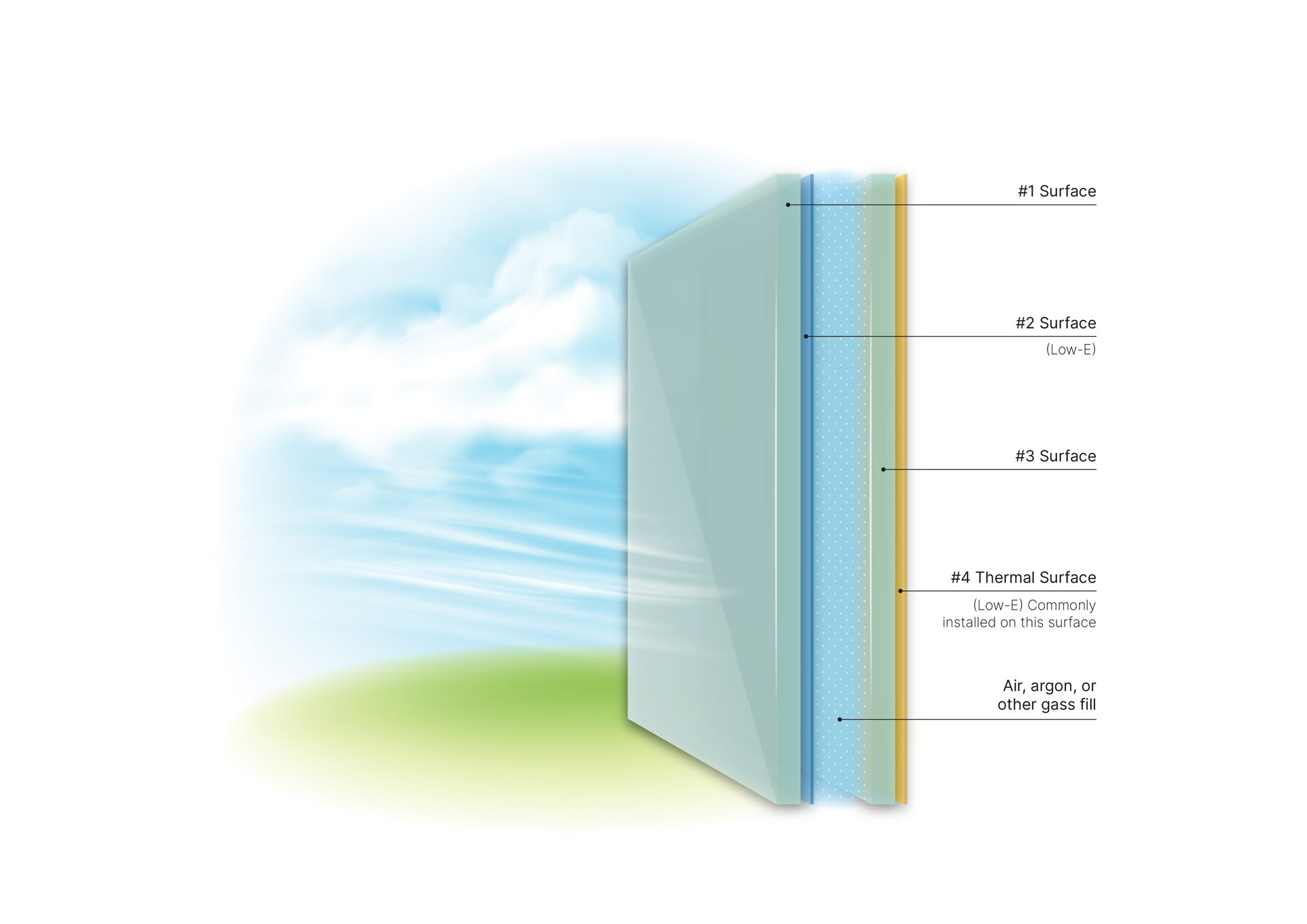
Understanding Glass Surface Numbers
Architectural glass is often described using surface numbers.
In a typical dual-pane insulated glass unit (IGU), the surfaces are numbered from the exterior toward the interior.
- Surface #1 – Exterior-facing surface
- Surface #2 – Interior side of the exterior pane
- Surface #3 – Exterior side of the interior pane
- Surface #4 – Interior-facing surface
Low-E coatings are most commonly found on Surface #2 or Surface #3.
The location of the coating can influence film compatibility and overall performance.
Can You See a Low-E Coating?
In most cases, Low-E coatings are nearly invisible.
Many property owners do not know their windows contain Low-E glass until a compatibility review is performed.
Specialized testing equipment is often used by glazing professionals and window film professionals to identify coating locations.
How Can I Tell If My Windows Have Low-E Glass?
Several clues may indicate the presence of Low-E glass:
- The building was constructed relatively recently.
- The windows are marketed as energy efficient.
- The windows are ENERGY STAR® rated.
- Manufacturer documentation references Low-E technology.
However, visual inspection alone is not always reliable.
If compatibility is important, professional verification is often recommended.
Can Window Film Be Installed on Low-E Glass?
Yes, but compatibility must be verified.
Many architectural films can be successfully installed on Low-E glass when the proper product is selected.
However, not every film is suitable for every Low-E window system.
Factors such as coating type, coating location, glass construction, window size, and environmental conditions must be considered.
Architectural Films Commonly Evaluated for Low-E Glass
Compatibility should always be reviewed on a case-by-case basis, but products commonly evaluated for Low-E applications include:
- Panashield Ceramic Film
- Dualflex Solar Control Film
- Sputterflex Solar Control Film
- Chromoflex Reflective Film
The best product depends on the specific glass and the goals of the project.
Why Compatibility Reviews Matter
Low-E glass is one of the most important variables in architectural film selection.
Without knowing whether a Low-E coating is present, it is difficult to provide reliable film recommendations.
This is why Flexfilm's Film-to-Glass Compatibility Calculator and compatibility review process place significant emphasis on identifying Low-E glass whenever possible.
Key Takeaways
- Low-E glass contains a specialized energy-efficient coating.
- Low-E coatings are common in modern homes and commercial buildings.
- Low-E glass can affect architectural film compatibility.
- Not all Low-E coatings are the same.
- Many architectural films can be installed on Low-E glass when compatibility is verified.
- Proper glass identification is an important part of film selection.


On this Page
-
Understanding Low-E Glass
- What Is Low-E Glass?
- How Does Low-E Glass Work?
- Why Does Low-E Glass Matter When Choosing Window Film?
- Different Types of Low-E Glass
- Understanding Glass Surface Numbers
- Can You See a Low-E Coating?
- How Can I Tell If My Windows Have Low-E Glass?
- Can Window Film Be Installed on Low-E Glass?
- Architectural Films Commonly Evaluated for Low-E Glass
- Why Compatibility Reviews Matter
- Key Takeaways